Indian Plant Antiviral Compound Database (IMPAC)
| Indian Plant Antiviral Compound | Description |
|---|---|
| InAVPCDB Accession Number | AVD012 |
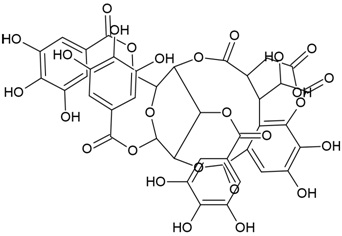
| Compound Name | Chebulinic acid |
| Phytochemical category | Polyphenolic tannin |
| PubChem Id | 72284 |
| IUPAC Name | 2-[(4R,5S,7R,8R,11S,12S,13S,21S)-13,17,18-trihydroxy-2,10,14-trioxo-5,21-bis[(3,4,5-trihydroxybenzoyl)oxy]-7-[(3,4,5-trihydroxybenzoyl)oxymethyl]-3,6,9,15-tetraoxatetracyclo[10.7.1.14,8.016,20]henicosa-1(19),16(20),17-trien-11-yl]acetic acid |
| Molecular Formula | C41H32O27 |
| Canonical SMILES Notation | C1=C(C=C(C(=C1O)O)O)C(=O)OCC2C3C(C(C(O2)OC(=O)C4=CC(=C(C(=C4)O)O)O)OC(=O)C5=CC(=C(C6=C5C(C(C(=O)O3)CC(=O)O)C(C(=O)O6)O)O)O)OC(=O)C7=CC(=C(C(=C7)O)O)O |
| Binomial Name | Terminalia chebula |
| Vernacular Names | Kadukkai/Karakkaya/Harad/Myrobalan |
| Plant Part | Fruit |
| Family | Combretaceae |
| Description | Herpes Simplex virus-2, Chikungunya, Dengue, and SARS-CoV-2. |
| Mechanism of action | It inhibits the viral glycoprotein's host-attachment mechanism; inhibts DNA gyrase activity. |
| Molecular weight | 956.68 g/mol |
| XLOGP3 | 0.66 |
| Num. H-bond acceptors | 27 |
| Num. H-bond donors | 13 |
| Rotatable bonds | 12 |
| Topological polar surface area | 447.09 Ų |
| Bioavailability Score | 0.66 |
| Druglikeness | No |
| Lipinski | 3 violations |
| References | Li P, Du R, Wang Y, Hou X, Wang L, Zhao X, Zhan P, Liu X, Rong L, Cui Q. Identification of chebulinic acid and chebulagic acid as novel influenza viral neuraminidase inhibitors. Frontiers in microbiology. 2020 Feb 28;11:182. Thomas N, Kumar S, Kumar V, Tapryal S. 1352. A Computational Approach for Exploring the Binding Mechanism of Chebulinic Acid on Herpes Simplex Virus-2 and Its Implication on Chikungunya and Dengue. InOpen Forum Infectious Diseases 2018 Nov (Vol. 5, No. Suppl 1, p. S414). Oxford University Press. |
