Home Antiviral Plant Compound Database

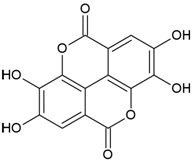
Ellagic acid

by impac.co.in

Indian Plant Antiviral Compound Database (IMPAC)

Indian Plant Antiviral Compound Description
InAVPCDB Accession Number AVD017
Compound Name Ellagic acid
Phytochemical category heterotetracyclic tannin
PubChem Id 5281855
IUPAC Name6,7,13,14-tetrahydroxy-2,9-dioxatetracyclo[6.6.2.04,16.011,15]hexadeca-1(15),4,6,8(16),11,13-hexaene-3,10-dione
Molecular Formula C14H6O8
Canonical SMILES Notation C1=C2C3=C(C(=C1O)O)OC(=O)C4=CC(=C(C(=C43)OC2=O)O)O
Binomial Name Terminalia chebula
Vernacular Names Kadukkai/Karakkaya/Harad/Myrobalan
Plant Part Fruit
Family Combretaceae
Description Human rhinovirus, Human papilloma virus, Hepatitis B virus, and SARS-CoV-2.
Mechanism of action It strongly inhibits the viral replication process by targetting the host cellular mechanism like increasing antioxidants.
Molecular weight 302.19 g/mol
XLOGP3 1.1
Num. H-bond acceptors 8
Num. H-bond donors 4
Rotatable bonds 0
Topological polar surface area 141.34 Ų
Bioavailability Score 0.55
Druglikeness Yes
Lipinski 0 violation
References Park SW, Kwon MJ, Yoo JY, Choi HJ, Ahn YJ. Antiviral activity and possible mode of action of ellagic acid identified in Lagerstroemia speciosa leaves toward human rhinoviruses. BMC complementary and alternative medicine. 2014 Dec;14(1):1-8. David AB, Diamant E, Dor E, Barnea A, Natan N, Levin L, Chapman S, Mimran LC, Epstein E, Zichel R, Torgeman A. Identification of SARS-CoV-2 Receptor Binding Inhibitors by In Vitro Screening of Drug Libraries. Molecules. 2021 Jan;26(11):3213.

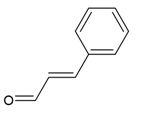
E-cinnamaldehyde

by impac.co.in

Indian Plant Antiviral Compound Database (IMPAC)

Indian Plant Antiviral Compound Description
InAVPCDB Accession Number AVD016
Compound Name E-cinnamaldehyde
Phytochemical category Phenyl propanoid/stereoisomer
PubChem Id 637511
IUPAC Name(E)-3-phenylprop-2-enal
Molecular Formula C9H8O
Canonical SMILES Notation C1=CC=C(C=C1)C=CC=O
Binomial Name Cinnamonium verum
Vernacular Names Pattai//Dalchini
Plant Part Tree bark
Family ?Lauraceae
Description Murine norovirus, Ffeline calicivirus, Hepatitis A virus, and Influenza viruses
Mechanism of action It may block the hemagglutinin function and results in the inhibition of viral entry into the cell.?
Molecular weight 132.16 g/mol
XLOGP3 1.9
Num. H-bond acceptors 1
Num. H-bond donors 0
Rotatable bonds 2
Topological polar surface area 17.07 Ų
Bioavailability Score 0.55
Druglikeness Yes
Lipinski 0 violation
References Asif M, Saleem M, Saadullah M, Yaseen HS, Al Zarzour R. COVID-19 and therapy with essential oils having antiviral, anti-inflammatory, and immunomodulatory properties. Inflammopharmacology. 2020 Aug 14:1-9. Fatima M, Sadaf Zaidi NU, Amraiz D, Afzal F. In vitro antiviral activity of Cinnamomum cassia and its nanoparticles against H7N3 influenza a virus. Journal of microbiology and biotechnology. 2016;26(1):151-9.

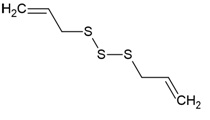
Diallyl trisulfide

by impac.co.in

Indian Plant Antiviral Compound Database (IMPAC)

Indian Plant Antiviral Compound Description
InAVPCDB Accession Number AVD015
Compound Name Diallyl trisulfide
Phytochemical category Trisulfide
PubChem Id 16315
IUPAC Name3-(prop-2-enyltrisulfanyl)prop-1-ene
Molecular Formula C6H10S3
Canonical SMILES Notation C=CCSSSCC=C
Binomial Name Allium sativum
Vernacular Names Vellaipoondu/Lasan/Vellulli/Garlic
Plant Part Shoot/Bulb
Family Alliaceae
Description Influenza B, Herpes simplex virus type 1 and type 2, Human immunodeficiency virus, and SARS-CoV-2.
Mechanism of action It inhibits the replication in earlier period of viral cycle before viral DNA synthesis; reduces the viral load.
Molecular weight 178.34 g/mol
XLOGP3 2.64
Num. H-bond acceptors 0
Num. H-bond donors 0
Rotatable bonds 6
Topological polar surface area 75.90 Ų
Bioavailability Score 0.55
Druglikeness Yes
Lipinski 0 violation
References Shoji S, Furuishi K, Yanase R, Miyazaka T, Kino M. Allyl compounds selectively killed human immunodeficiency virus (type 1)-infected cells. Biochemical and biophysical research communications. 1993 Jul 30;194(2):610-21. Tsai Y, Cole LL, Davis LE, Lockwood SJ, Simmons V, Wild GC. Antiviral properties of garlic: in vitro effects on influenza B, herpes simplex and coxsackie viruses. Planta medica. 1985 Oct;51(05):460-1.

Curcumin

by impac.co.in

Indian Plant Antiviral Compound Database (IMPAC)

Indian Plant Antiviral Compound Description
InAVPCDB Accession Number AVD014
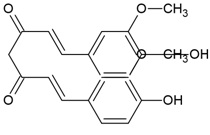
Compound Name Curcumin
Phytochemical category Polyphenol
PubChem Id 969516
IUPAC Name(1E,6E)-1,7-bis(4-hydroxy-3-methoxyphenyl)hepta-1,6-diene-3,5-dione
Molecular Formula C21H20O6
Canonical SMILES Notation COC1=C(C=CC(=C1)C=CC(=O)CC(=O)C=CC2=CC(=C(C=C2)O)OC)O
Binomial Name Curcuma longa
Vernacular Names Manjal/Pasupu/Haldhi/Turmeric
Plant Part Rhizome
Family Zingiberaceae
Description Human immuno deficiency, Herpes viruses, and SARS-CoV-2.
Mechanism of action It restrains direct interaction with viral membrane proteins and disruption of the viral envelope; inhibits viral proteases; induces host antiviral responses; suppression of cellular signaling pathways essential for viral replication, such as PI3K/Akt, NF-?B.
Molecular weight 368.38 g/mol
XLOGP3 3.2
Num. H-bond acceptors 6
Num. H-bond donors 2
Rotatable bonds 8
Topological polar surface area 93.06 Ų
Bioavailability Score 0.55
Druglikeness Yes
Lipinski 0 violation
References Harikumar KB, Kuttan R. Antiviral activity of Phyllanthus amarus and curcumin. Amla Res Bull. 2006;26:198?205. Thimmulappa RK, Kumar MN, Shivamallu C, Subramaniam KT, Radhakrishnan A, Suresh B, Kuppusamy G. Antiviral and immunomodulatory activity of curcumin: A case for prophylactic therapy for COVID-19. Heliyon. 2021 Feb 22:e06350.

Corilagin

by impac.co.in

Indian Plant Antiviral Compound Database (IMPAC)

Indian Plant Antiviral Compound Description
InAVPCDB Accession Number AVD013
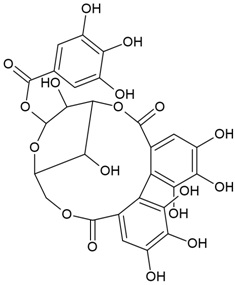
Compound Name Corilagin
Phytochemical category Flavanoid
PubChem Id 73568
IUPAC Name[(1S,19R,21S,22R,23R)-6,7,8,11,12,13,22,23-octahydroxy-3,16-dioxo-2,17,20-trioxatetracyclo[17.3.1.04,9.010,15]tricosa-4,6,8,10,12,14-hexaen-21-yl] 3,4,5-trihydroxybenzoate
Molecular Formula C27H22O18
Canonical SMILES Notation C1C2C(C(C(C(O2)OC(=O)C3=CC(=C(C(=C3)O)O)O)O)OC(=O)C4=CC(=C(C(=C4C5=C(C(=C(C=C5C(=O)O1)O)O)O)O)O)O)O
Binomial Name Phyllanthus amarus
Vernacular Names Kizhanelli/Nela Usiri/Bhui Amala
Plant Part Leaf
Family Phyllanthaceae
Description Hepatitis viruses, Human enterovirus, Coxsackievirus and SARS-CoV-2
Mechanism of action It inhibits viral proteases and reverse trancriptases; restricts viral replicaiton.
Molecular weight 634.45 g/mol
XLOGP3 0.07
Num. H-bond acceptors 18
Num. H-bond donors 11
Rotatable bonds 3
Topological polar surface area 310.66 Ų
Bioavailability Score 0.17
Druglikeness No
Lipinski 3 violations
References Yeo SG, Song JH, Hong EH, Lee BR, Kwon YS, Chang SY, Kim SH, won Lee S, Park JH, Ko HJ. Antiviral effects of Phyllanthus urinaria containing corilagin against human enterovirus 71 and Coxsackievirus A16 in vitro. Archives of pharmacal research. 2015 Feb;38(2):193-202. Hiremath S, Kumar HV, Nandan M, Mantesh M, Shankarappa KS, Venkataravanappa V, Basha CJ, Reddy CL. In silico docking analysis revealed the potential of phytochemicals present in Phyllanthus amarus and Andrographis paniculata, used in Ayurveda medicine in inhibiting SARS-CoV-2. 3 Biotech. 2021 Feb;11(2):1-8.

 Chebulinic acid

by impac.co.in

Indian Plant Antiviral Compound Database (IMPAC)

Indian Plant Antiviral Compound Description
InAVPCDB Accession Number AVD012
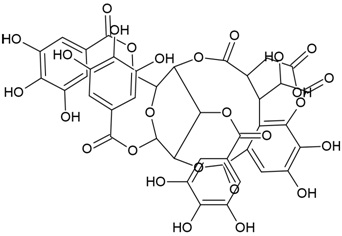
Compound Name Chebulinic acid
Phytochemical category Polyphenolic tannin
PubChem Id 72284
IUPAC Name2-[(4R,5S,7R,8R,11S,12S,13S,21S)-13,17,18-trihydroxy-2,10,14-trioxo-5,21-bis[(3,4,5-trihydroxybenzoyl)oxy]-7-[(3,4,5-trihydroxybenzoyl)oxymethyl]-3,6,9,15-tetraoxatetracyclo[10.7.1.14,8.016,20]henicosa-1(19),16(20),17-trien-11-yl]acetic acid
Molecular Formula C41H32O27
Canonical SMILES Notation C1=C(C=C(C(=C1O)O)O)C(=O)OCC2C3C(C(C(O2)OC(=O)C4=CC(=C(C(=C4)O)O)O)OC(=O)C5=CC(=C(C6=C5C(C(C(=O)O3)CC(=O)O)C(C(=O)O6)O)O)O)OC(=O)C7=CC(=C(C(=C7)O)O)O
Binomial Name Terminalia chebula
Vernacular Names Kadukkai/Karakkaya/Harad/Myrobalan
Plant Part Fruit
Family Combretaceae
Description Herpes Simplex virus-2, Chikungunya, Dengue, and SARS-CoV-2.
Mechanism of action It inhibits the viral glycoprotein's host-attachment mechanism; inhibts DNA gyrase activity.
Molecular weight 956.68 g/mol
XLOGP3 0.66
Num. H-bond acceptors 27
Num. H-bond donors 13
Rotatable bonds 12
Topological polar surface area 447.09 Ų
Bioavailability Score 0.66
Druglikeness No
Lipinski 3 violations
References Li P, Du R, Wang Y, Hou X, Wang L, Zhao X, Zhan P, Liu X, Rong L, Cui Q. Identification of chebulinic acid and chebulagic acid as novel influenza viral neuraminidase inhibitors. Frontiers in microbiology. 2020 Feb 28;11:182. Thomas N, Kumar S, Kumar V, Tapryal S. 1352. A Computational Approach for Exploring the Binding Mechanism of Chebulinic Acid on Herpes Simplex Virus-2 and Its Implication on Chikungunya and Dengue. InOpen Forum Infectious Diseases 2018 Nov (Vol. 5, No. Suppl 1, p. S414). Oxford University Press.

Chebulic acid

by impac.co.in

Indian Plant Antiviral Compound Database (IMPAC)

Indian Plant Antiviral Compound Description
InAVPCDB Accession Number AVD011
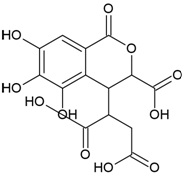
Compound Name Chebulic acid
Phytochemical category Phenol
PubChem Id 71308174
IUPAC Name(2S)-2-[(3S,4S)-3-carboxy-5,6,7-trihydroxy-1-oxo-3,4-dihydroisochromen-4-yl]butanedioic acid
Molecular Formula C14H12O11
Canonical SMILES Notation C1=C2C(=C(C(=C1O)O)O)C(C(OC2=O)C(=O)O)C(CC(=O)O)C(=O)O
Binomial Name Terminalia chebula
Vernacular Names Kadukkai/Karakkaya/Harad/Myrobalan
Plant Part Fruit
Family Combretaceae
Description Herpes virus type 2, Influenza A virus, and SARS-CoV-2.
Mechanism of action It inhibits neuraminidase-mediated viral release mechanism; inhibits viral attachment, penetration, post-infection viral replication.
Molecular weight 356.24 g/mol
XLOGP3 -0.81
Num. H-bond acceptors 11
Num. H-bond donors 6
Rotatable bonds 5
Topological polar surface area 198.89 Ų
Bioavailability Score 0.11
Druglikeness No
Lipinski 2 violations
References Li P, Du R, Wang Y, Hou X, Wang L, Zhao X, Zhan P, Liu X, Rong L, Cui Q. Identification of chebulinic acid and chebulagic acid as novel influenza viral neuraminidase inhibitors. Frontiers in microbiology. 2020 Feb 28;11:182. Kesharwani A, Polachira SK, Nair R, Agarwal A, Mishra NN, Gupta SK. Anti-HSV-2 activity of Terminalia chebula Retz extract and its constituents, chebulagic and chebulinic acids. BMC complementary and alternative medicine. 2017 Dec;17(1):1-1.
Newer Posts
Older Posts