Indian Plant Antiviral Compound Database (IMPAC)
| Indian Plant Antiviral Compound | Description |
|---|---|
| InAVPCDB Accession Number | AVD016 |
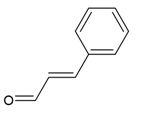
| Compound Name | E-cinnamaldehyde |
| Phytochemical category | Phenyl propanoid/stereoisomer |
| PubChem Id | 637511 |
| IUPAC Name | (E)-3-phenylprop-2-enal |
| Molecular Formula | C9H8O |
| Canonical SMILES Notation | C1=CC=C(C=C1)C=CC=O |
| Binomial Name | Cinnamonium verum |
| Vernacular Names | Pattai//Dalchini |
| Plant Part | Tree bark |
| Family | ?Lauraceae |
| Description | Murine norovirus, Ffeline calicivirus, Hepatitis A virus, and Influenza viruses |
| Mechanism of action | It may block the hemagglutinin function and results in the inhibition of viral entry into the cell.? |
| Molecular weight | 132.16 g/mol |
| XLOGP3 | 1.9 |
| Num. H-bond acceptors | 1 |
| Num. H-bond donors | 0 |
| Rotatable bonds | 2 |
| Topological polar surface area | 17.07 Ų |
| Bioavailability Score | 0.55 |
| Druglikeness | Yes |
| Lipinski | 0 violation |
| References | Asif M, Saleem M, Saadullah M, Yaseen HS, Al Zarzour R. COVID-19 and therapy with essential oils having antiviral, anti-inflammatory, and immunomodulatory properties. Inflammopharmacology. 2020 Aug 14:1-9. Fatima M, Sadaf Zaidi NU, Amraiz D, Afzal F. In vitro antiviral activity of Cinnamomum cassia and its nanoparticles against H7N3 influenza a virus. Journal of microbiology and biotechnology. 2016;26(1):151-9. |
